Your till is ringing sales. iVend isn't recording them.
A ghosted POS is the most dangerous kind of failure: the store looks fine, customers are paying, and your records are quietly drifting. Pulse catches it in real time, before end of day becomes a reconciliation disaster.
The cost of not catching this.
Reconciliation disaster ($)
A POS that ran $8,000 in card sales but didn't sync produces a discrepancy that takes 2–4 hours to unpick at EOD. Across a 20-store estate, this happens 3–5 times per month.
Invisible loss prevention risk
Ghost transactions are indistinguishable from till manipulation in an EOD review. Loss prevention chases employee fraud when the real culprit is a stale agent connection.
Audit exposure at stocktake
If a ghosted POS spans a fiscal period boundary, your inventory count is wrong at stocktake. That's a board-level problem dressed as an IT problem.
How Pulse catches it.
Agent heartbeat monitoring
Pulse's edge agent phones home every 5 minutes. A terminal that stops reporting while the till application is still active is flagged as ghosted — not just offline.
Replication lag tracking
Pulse compares the last iVend transaction timestamp against the last POS timestamp. A growing gap triggers amber; beyond your configurable threshold, it fires red.
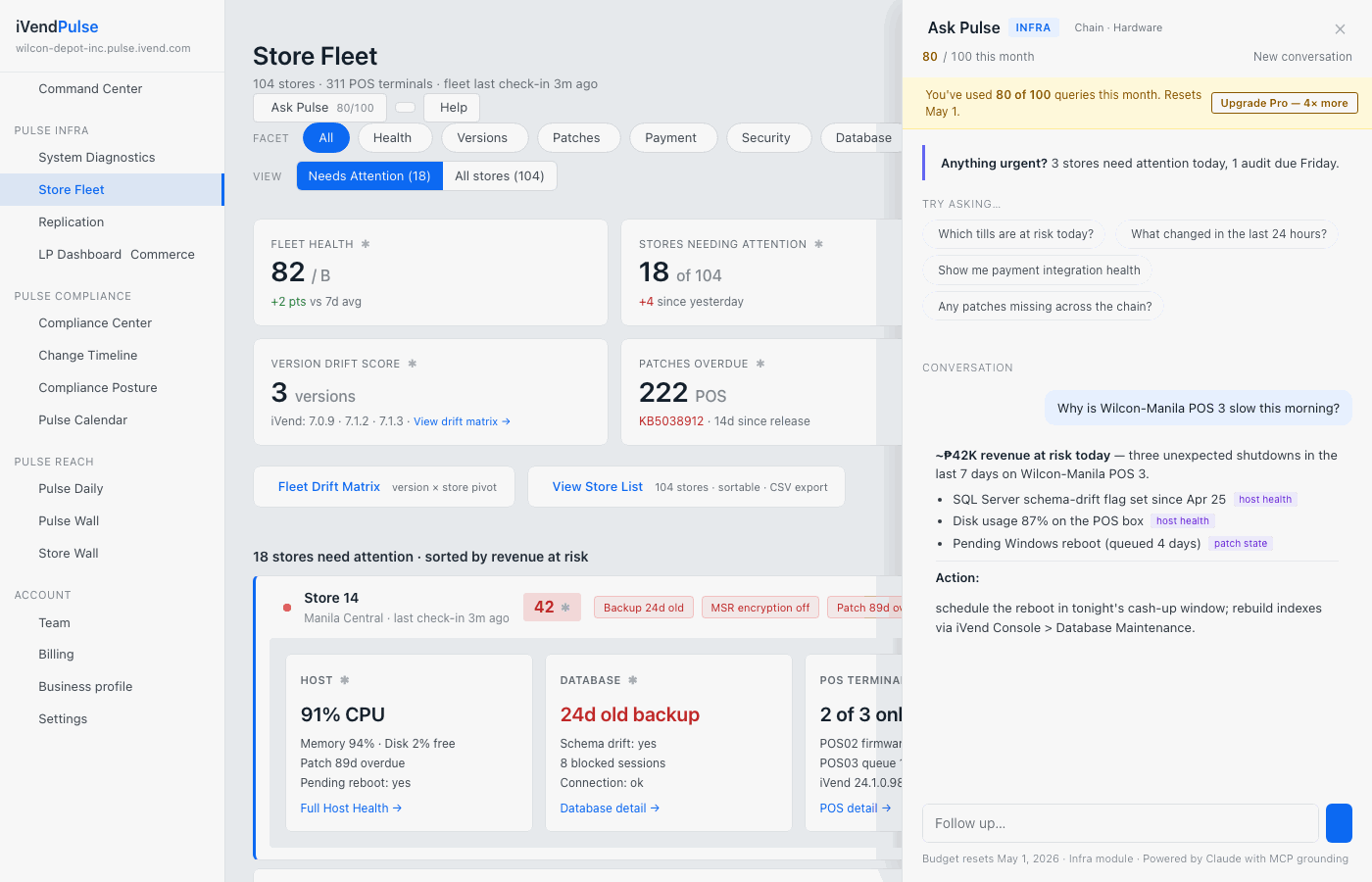
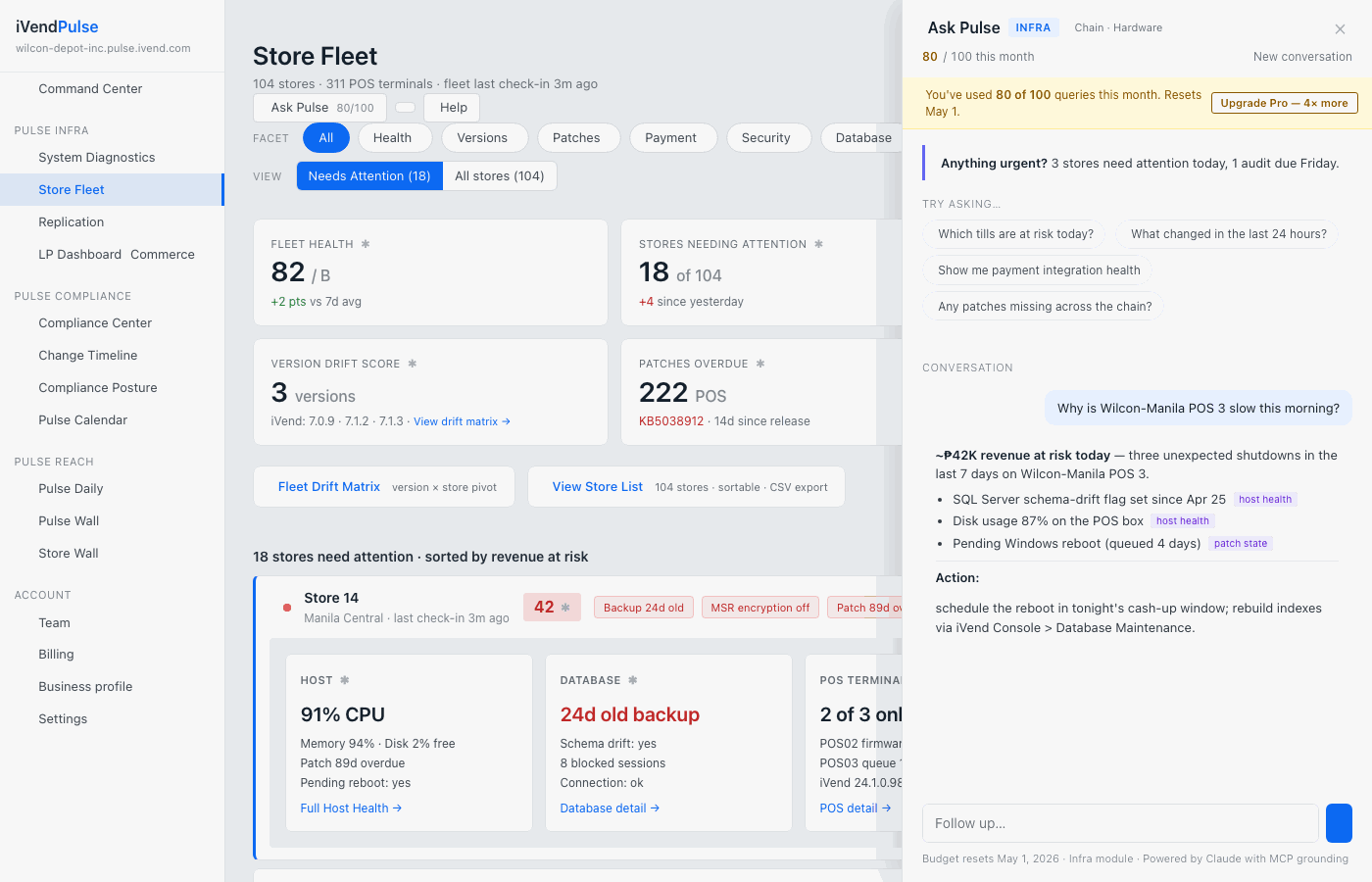
Ask Pulse query
"Which tills are ghosted right now?" returns store, terminal ID, last-seen time, and lag in minutes — in one question, without leaving the canvas.
What you'd see.
Is this your problem to solve?
Two roles own ghosted POS — one detects, one decides.
What it costs.
Ghosted POS detection is part of Pulse Infra — per-POS-terminal, billed monthly. Standard tier includes real-time ghost detection; Pro adds 24-hour lag history and email alerting to multiple recipients.
Estimate your monthly cost
Worked example — Chain M (FreshMart)
- 3 Infra Pro seats × $69 = $207
- 48 POS @ Pro band (50 × $7) = $336
- 12 Store Manager seats × $19 = $228
- 1 Compliance Standard seat (bundled with Infra) = $0
- = $771/mo USD